
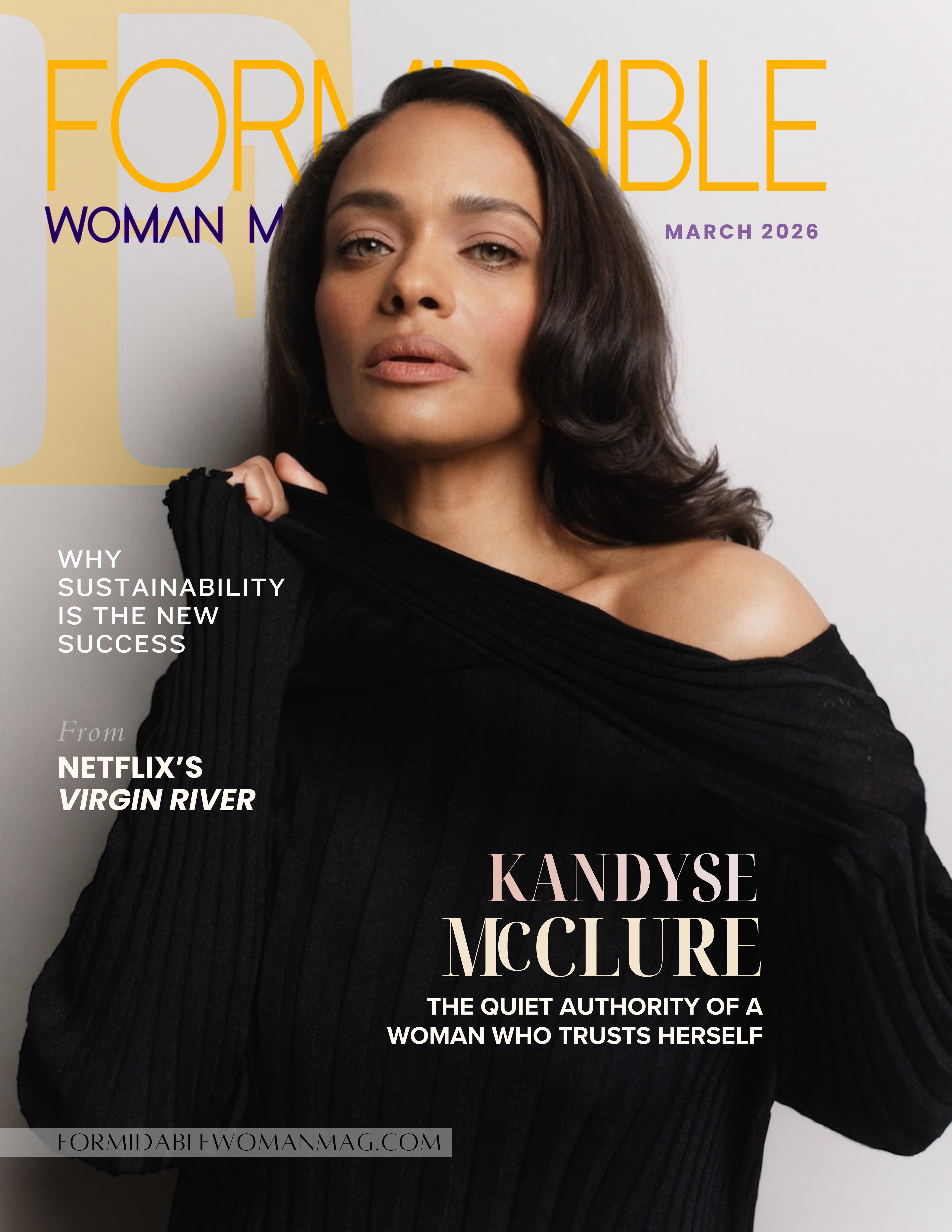
There is a difference between visibility and authority, and Kandyse McClure has lived long enough to know it. Known globally for her work on Netflix’s Virgin River and a career that spans nearly three decades, McClure no longer defines confidence by attention or applause. What once depended on external validation has matured into something steadier, quieter, and far more powerful. In this Spring Digital Cover Feature for Formidable Woman® Magazine, she reflects on rebuilding her life, redefining success, and discovering that true longevity is not about momentum, it’s about evolution. Her story is not one of constant ascent, but of recalibration, courage, and choosing growth over comfort — again and again.
Confidence, Rewritten
FWM: You’ve built a career that spans television, film, and global audiences. How has your definition of confidence evolved as both a woman and an artist over the years?
KM: Confidence is so much quieter now than it used to be. Earlier in my career, it was external — getting the role, being seen by the right casting directors, being booked and busy. I measured my worth by how much the industry was paying attention to me. And that’s a dangerous metric because the industry’s attention is fickle.
What’s shifted is that confidence has become an inside job. It’s about being honest with yourself about who you really are — not the version of you that performs well in a room, but the actual person underneath. What are your needs? What’s your capacity? Where are your boundaries? I’ve learned to listen to my instincts without negotiating with them. There was a time in my life when I talked myself out of things I knew to be true, and it cost me. So now, confidence means trusting myself — and showing up for myself — without waiting for someone else to confirm I’m allowed to.
FWM: In an industry known for reinvention and resilience, what has allowed you to sustain both relevance and personal integrity across decades of work?
KM: A willingness to change. Not just professionally, but personally. I’ve had to let go of versions of myself that no longer fit, even when that felt terrifying. There were years when I stepped away from acting entirely and had to rebuild my life from scratch — career, finances, sense of self, all of it. And that experience, as brutal as it was, taught me that longevity isn’t about sticking to the same playbook. It’s about staying honest about what’s working and what isn’t.
I’ve also learned that everything I ever wanted was on the other side of something I didn’t want to do. Every meaningful breakthrough — personal or professional — came from a moment where I had to choose between comfort and growth. And comfort almost always looked like staying still. So I keep choosing the uncomfortable thing. It doesn’t get easier, but you get braver. And you start to trust the pattern: that recalibrating isn’t failure. Sometimes starting over is the most courageous thing you can do.
I booked Virgin River in my forties, after years of thinking the best was behind me.
Living Out Loud in the Messy Middle
FWM: What does living out loud mean to you at this stage of your life and career, and how does that show up in the roles you choose today?
KM: Living out loud, for me, means allowing myself to be in process — publicly, imperfectly, without pretending to have it all figured out. For years I performed an appropriate version of myself. Polished, contained, the right answer at the right time. It felt safe. But safety and authenticity don’t always live in the same house.
Now I’m more interested in emotional availability than emotional control. I’m a naturally curious person, and I’ve learned that curiosity and vulnerability are the same muscle. The roles I’m drawn to now reflect that — they’re about women in the messy middle. Women failing and figuring it out. Kaia on Virgin River is exactly that. She’s a can-do, will-try woman who made a radical choice to stay in one place for love after years of running. And Season 7 tests that choice hard. I love stories that feel truer to life, where a woman is complicated and layered but ultimately makes it make sense. That’s the kind of living out loud that interests me.
FWM: Many women see the finished performance, but not the discipline behind it. What does your preparation process look like when stepping into complex or emotionally layered roles?
KM: It starts from the inside out. I’m a research nerd at heart — I want to know everything. The job, the history, the climate, the family dynamics, whatever rabbit holes it takes me down. I need to understand the emotional world a character operates in before I can inhabit it. Where does she come from? What’s she afraid of? What does she think she wants versus what she actually needs?
Then I need to get all of that into my body. Movement is huge for me. How does she walk, how does she hold tension, what does she do with her hands when she’s nervous? The discipline is in filling in every blank space — knowing the world and the words so thoroughly that when I get to set, I can let all of it go. That’s the paradox of preparation: you do all that work so you can forget it. So you can just be there with everyone — fluid, present, responsive. Then it’s time to play. The playing is the whole point.
Representation, Responsibility, and Possibility
FWM: As a woman whose work reaches global audiences, how do you view the responsibility (or opportunity) that comes with visibility, especially for women watching your journey?
KM: I see it as an opportunity, more than a responsibility. An opportunity to reflect back possibility.
Growing up between South Africa and Canada, I was deeply aware of how stories shape who you believe you can become. My mother was an educator and activist — she did that work during apartheid — and she taught me early that representation isn’t just about seeing someone who looks like you on screen. It’s about seeing the range of what’s possible. There’s no single timeline, no fixed version of success, and no one way to navigate this industry or this life. Everyone’s path is different, and that’s precisely the point.
I booked Virgin River in my forties, after years of thinking the best was behind me. If someone out there sees my journey and feels less alone in theirs, or recognizes that other possibilities exist for them — that their story isn’t finished yet — then the visibility means something. You never know what will happen until you start, until you say yes and go forward.
If someone sees my journey and realizes their story isn’t finished yet — then the visibility means something
FWM: You’ve worked alongside some of the industry’s most respected names. What lessons have stayed with you from those experiences, and how have they shaped the way you move now?
KM: The biggest lesson is one I keep relearning: everyone is human, no matter how accomplished. And you don’t have to be nice to be kind. Those are different things. Niceness can be performative. Kindness is a choice that costs you something.
The people I’ve admired most in this industry — across nearly three decades of working with them — are the ones who stay curious about the people around them, who are generous with their craft but hold firm boundaries, and who never compromise on the integrity of the work. They understand that a set is a collaboration, especially when the days are long and the pressure is high. Standards matter, but so does compassion.
I spent six years on Battlestar Galactica, and that experience shaped how I carry myself on every set since. We don’t do this alone. Everyone plays an important role, from the lead to the background performer to the person pulling cable. Our gift as actors is the ability to put ourselves in someone else’s shoes — and that should extend beyond the camera. Longevity in this business isn’t built on talent alone. So much of it comes down to your relationships and how you treat people. They will remember how you made them feel.
Rooted in Identity
FWM: Success often shifts over time. How do you personally measure success today, and how is it different from earlier chapters of your career?
KM: I have only ever wanted to be a working actor. To be able to take care of myself and my family through this craft. And I’m so deeply grateful that I get to do that.
But the definition has expanded. Success now is about sustainability — emotional, creative, physical. It’s about being able to withstand the roller coaster this line of work inevitably is, while maintaining a balance in life that feels aligned and spacious. Not frantic. Not performative. Earlier in my career, I chased momentum and visibility. I wanted to be impressive. Now I’m drawn to exploration — to the freedom to make artistic choices rather than purely financial ones, to feeling deeply connected to the work I take on rather than just relieved I booked it.
And there’s a quieter measure too: staying recognizable to the people who know me well. Success means nothing if you become unrecognizable to the people you love in the process. I want to be the same person on set that I am at my kitchen table. That’s the real benchmark.
Success means nothing if you become unrecognizable to the people you love.
FWM: From South Africa to international stages, your journey has crossed continents and cultures. How has that global perspective influenced your voice, your choices, and your sense of purpose?
KM: I’m a third-culture kid. Born in Durban, raised between South Africa and Vancouver, and I’ve lived in other parts of the world along the way. You grow up between worlds when you live like that — never quite fitting into the one you left or the one you arrive in, but occupying this liminal space that’s an amalgam of both. It can be disorienting. But it also makes you more empathetic, more aware of complexity, more attuned to the things that connect people across vastly different experiences.
That awareness shapes everything for me. It shapes the stories I’m drawn to — stories that explore our relationship to memory, to personal and family history, to the unspoken emotional truths that travel across generations. My mother’s activism in South Africa taught me that identity is never simple and never finished. It’s layered and evolving. And belonging isn’t always straightforward. Sometimes you have to build it yourself.
I carry that perspective into every role. It’s why Ubuntu — the South African philosophy of “I am because we are” — resonates so deeply with me. Nothing I do in this industry is done alone.
Permission and Rebirth
FWM: What practices, values, or rituals help you stay grounded amid the fast pace and visibility of the entertainment industry?
KM: Adventures and nature are essential. A stormy coast, a windswept mountain, a high dry desert — all of it. We do a lot of walking and I’m always foraging wherever we go. That sense of being small inside something vast is incredibly grounding.
But the daily version of that is the garden. I grow food on my apartment patio in containers and I also have plots in a community garden. We start setting seeds in the middle of winter, which feels like an act of faith every time. Then there’s the pleasure of cooking what I’ve grown. Exploration in the kitchen lights up the scientific part of my mind — I love to experiment with techniques and recipes, fermenting things, making ginger bug, turning whatever’s in the garden into something on the plate. It’s an accessible form of creativity that’s instantly rewarding. Not months on a show, but a couple of hours and voilà — something from nothing.
There’s so much value for me in the simplicity and routine of everyday walks and everyday meals. It’s how I stay connected to my body, by nourishing it. That’s not a wellness trend for me. It’s a way of life.
FWM: What would you say to the woman who is talented, capable, and ready, but still waiting for permission to step fully into her power?
KM: You’ll know when it’s time. It may not feel comfortable, but you’ll know. We always do. I think confusion is just knowing what needs to be done but resisting it. And the good news — and it is good news — is that no one is coming to give you permission. That means you can stop waiting.
Your power isn’t something you’re granted. It’s something you discover by trusting yourself, by showing up for yourself even when it’s terrifying. And every time you do, the trust compounds. You don’t have to be fearless. You just have to be willing to take one step forward.
I rebuilt my entire life in my late thirties. I started over with nothing. And then in my forties, I booked the best role of my career and married someone I’d loved since I was young. None of that happened because I was ready. It happened because I started. So start where you are. Let yourself be seen. You’re more ready than you think.
Safety and authenticity don’t always live in the same house.
FWM: What’s next for you — not just professionally, but personally — as you continue evolving as a woman, artist, and leader?
KM: Evolving is exactly it. This new creative chapter has me learning to develop original work, collaborating more with international artists and creatives, picking up new skills and giving myself permission to be in the process rather than rushing toward the product. I’m falling in love with the messy middle.
I’m on the board of the New West International Film Festival here in Vancouver, and I’m doing film selection and marketing for the South African Film Festival, which raises funds for Education Without Borders. That community work feeds me in ways I didn’t expect. It’s connected me back to the reason I got into this in the first place — the belief that stories can change how people see themselves and each other.
As long as it’s still fun, as long as I’m still curious, as long as it still lights me up inside — I keep going. There’s something so beautiful about returning to a beginner’s mind, where everything is possible. I’m so excited about this next season, both in my work and in life. It feels like a rebirth. Like there are whole chapters I’m about to write.
What becomes clear in speaking with Kandyse McClure is that her story is not about reinvention for reinvention’s sake, it is about refinement. About stripping away what no longer fits and choosing courage over comfort, even when it requires starting again. She has learned that visibility fades, momentum shifts, and seasons change, but self-trust endures. As she steps into this next chapter, developing original work, deepening community ties, and returning to a beginner’s mind, she does so not chasing applause, but guided by curiosity. For the Formidable Woman®, that may be the ultimate evolution: not proving, not performing, but becoming — deliberately, unapologetically, and on her own terms.
Confidence is our currency™. Live out loud™.
Photo credits: Liz Rosa
